Part I made the argument. Part II gave the test. Part III is the builder's story.
This website used to cost €10,000 to €20,000.
Designer. UX specialist. Developer. Deployment. Eight months ago, that was the standard for a site like this. You hired people, waited weeks, paid the invoice.
I built this one myself. With Claude. A browser tab. A few iterations.
Design, code, copy, deployment. You are reading the result. It is not worse.
The barrier did not get lower. It disappeared.
That same movement from expensive to free is what I thought I could build a business on.
In May 2025, I wrote a pitch document.
An AI system for e-commerce companies. Connect shop data, inventory, campaign performance, and customer signals. Output: one decision per day. Not more numbers. An actual recommendation. Push this product. Drop that campaign. Here is why.
My specific bet: not agents, not automation. Coordination.
Agents doing narrow tasks are easy to replicate. Anyone can build one. But orchestrating them intelligently — connecting the right inputs, sequencing the right decisions, making it useful for a real business — that was the hard part. I had eight years of domain knowledge for exactly this. A hundred clients. A built network. The concept was solid.
The bet was wrong.
What changed was not a competitor. It was a cost floor.
Part II showed what happened to agency work. A $25 workflow ran through research, targeting, copy, campaign structure in one afternoon. That had been our product.
What I saw next was one level up.
A workflow handling a complex chain of decisions, each step depending on the last, running at near-zero cost. Not for one use case. For anything.
That is not someone building a better version of my idea. That is the cost of coordination itself falling to zero.
If coordination is free, building a coordination layer is not a business.
The moat I had bet on was gone before I could start building it.
And then the examples started coming in from my network, from customer research conversations.
A development team recently built a complete, custom ERP system in eight weeks. A project of that complexity normally takes 18 months and costs over one million euros in development. They are in testing right now. It works.
That is not a hack. That is not a simplified version. It is the full system, built in eight weeks, by a small team with the same tools available to everyone.
And a Mittelstand owner rebuilt his company webshop in three days with an apprentice and AI. Old software subscription cancelled that week. New shop live. Quality good enough to go live.
The floor didn't just get lower. It became lava.
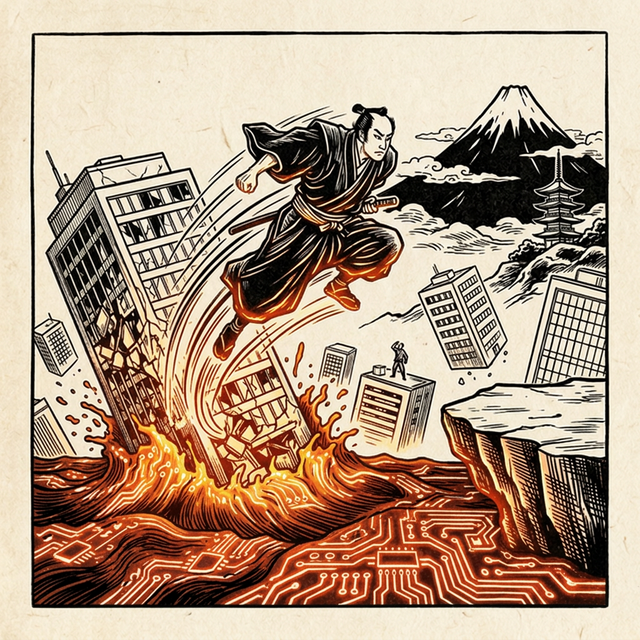
The floor is not just lower. For some, it becomes lava.
These are not average cases. Most organizations still have internal lag. Change is slow.
But they show where the floor is heading.
Not because every company gets there tomorrow. Because some already did. And because a small team with eight weeks, or an apprentice with three days, can now replace something that was supposed to take years and last decades.
Here is the question nobody is asking out loud:
Will your business be relevant in two years?
Most people cannot answer that honestly. Not because they do not know. Because they do not want to.
The standard comfort is: find your niche, and you will be safe. Specialize. Go deep. Own your corner.
That is not wrong. But it is not enough.
Because the floor does not respect niches. It reaches generalists first, then specialists. It reached design studios, copywriters, code shops. Then it reached the coordination layer I was building on. In eight weeks, a small team built what should have taken 18 months and a million euros.
Niche is not a moat. Niche is a delay.
The actual question is not whether your niche is defensible. The question is how fast the floor is moving toward it.
So ask yourself right now: which layer is your business betting on? And what is the honest half-life of that bet?
The floor is lava.
Speed gets you across. And the same tools moving the floor are the ones in your hands right now.
I built this website while figuring that out. It exists because the floor moved and I was already holding the tools.
Which moats actually hold, and for how long — that is Part IV.
This series
Part I: The Human Layer — What AI actually can't replace
Part II: The $25 Test — The first filter for your position
Part III: When Coordination Costs Nothing — What the floor looks like now (you are here)
Part IV: Which Moats Actually Hold — The map with two questions
Newsletter
Only when there is something worth saying. Unsubscribe anytime.
Not advice. I wrote a pitch. I watched it become irrelevant before I finished it. I talked to the teams building what should take years in weeks. Still running the questions.