Part I made the argument: whoever owns the human layer, the physical, haptic interface between AI and the final decision, owns the moat. This is the working framework. Four business types, two questions, one decision tree.
I started looking for what survives.
Observation 1: The old trades.
A private gym. A physio practice. A funeral home. A care home.
These businesses are safe. The core service happens in a body, in a room, with another person. AI cannot replicate that at scale.
But they don't profit from the AI revolution either. Their core stays manual. Their margins stay the same. The protection comes with a ceiling.
Observation 2: My own business.
A digital marketing agency is the opposite picture.
We used AI to get faster. AI-assisted research. AI-drafted copy. AI-generated briefs. It made us more efficient.
And it made every client wonder why they needed us. AI doesn't just help the agency. AI is the agency, for $25. That is the category the $25 workflow is eating.
Observation 3: "Just build an AI product."
The obvious answer: if AI disrupts your business, build an AI business. A wrapper. A tool. A workflow platform.
But look at what markets are pricing in. Adobe has lost over 60% of its value. Not because the business failed. Margins are 90%+. Revenue still grows. The market is pricing in one fear: AI will eat SaaS. Whether that is true, nobody knows yet.
They are right to worry. Executives are already replacing monthly SaaS subscriptions with custom-coded AI solutions. Not just productivity tools. ERP-level infrastructure software. The monthly fee is becoming a liability.
And if you build the AI wrapper to replace them: you are competing directly against OpenAI and Anthropic. They bundle your feature in the next update. For free. Without proprietary data or genuine network effects, you are in the most contested quadrant. AI helps you and AI replaces you.
That said: this space will produce some of the biggest companies of the next decade. Cursor. Perplexity. Companies that built distribution before the model providers caught up. And some SaaS that genuinely owns the human interface layer might be closer to Observation 4 than to Countdown. The honest framing is not "don't build AI." It's this: high risk, high reward. Most won't make it. A few will.
Observation 4: The principle at scale — and at micro.
Apple is the macro version of this logic. As Part I showed: they own the glass, collect the interface toll, and let whoever builds the best model run through their surface. Protected from disruption. Full upside from the revolution.
But Apple is also something else: one of the world's most successful direct-to-consumer brands. The iPhone is a physical product with 45%+ margins sold directly to end customers. They don't just own the pipeline. They sell the oil too.
That principle scales down. A founder with their own brand and a physical product is running the same logic. The product arrives at a door. Gets touched, tried on, kept or returned. That moment is human. And because the product is genuinely theirs, AI can't undercut it by finding a cheaper version elsewhere.
A real brand holds its price. A reseller collapses when AI agents start optimizing for the cheapest option. I saw this from inside the agency: own-brand businesses had margins to scale. Resellers hit a glass ceiling before they could get there.
Apple at macro scale. Your brand at micro scale. Same principle.
Four observations. One pattern.
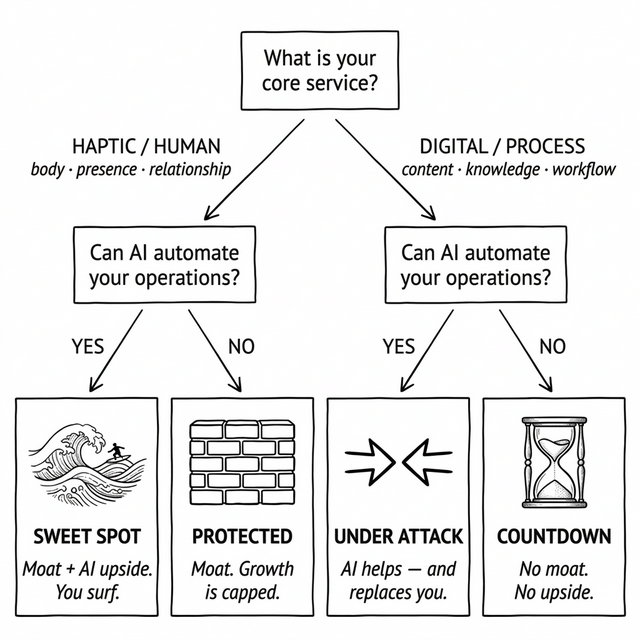
Two questions. Four outcomes. Run your business through them.
The old trades: haptic core, no AI upside. Protected. Capped.
My agency: AI upside, no haptic core. Under Attack.
The AI wrapper builder: no haptic core, no distribution moat. Fastest Countdown.
Apple: haptic product, AI-run operations. Sweet Spot. At any scale.
The $25 workflow doesn't end business. It ends the business model that was only ever selling process — and calling it expertise.
If your core service requires a human body in a room, a physical product at a door, or a relationship that compounds over time, the wave doesn't threaten you. It hands you an efficiency advantage over everyone who thought the same workflow was their value proposition.
Run the two questions again in eighteen months. The flowchart stays the same. The thresholds keep moving.
This series
Part I: The Human Layer — What AI actually can't replace
Part II: The $25 Test — The first filter for your position (you are here)
Part III: When Coordination Costs Nothing — What the floor looks like now
Part IV: Which Moats Actually Hold — The map with two questions
Newsletter
Only when there is something worth saying. Unsubscribe anytime.
Not advice. I watched the $25 workflow. I left the agency. I'm still looking.