Almost every business conversation arrives at the same place right now. Nobody says it out loud. But it is always there.
Will AI replace us?
Not as an abstract fear. As a real question with real consequences. One that changes what you build next, what you sell, and whether the thing you spent years creating still has value in three years.
Most people have no answer. A few have a guess. Almost nobody has a framework.
This series is four parts. Four things, in order:
An observation — one layer survives the automation wave. This is the argument for which one.
A test — a $25 AI workflow, and what it tells you about your business model.
An analysis — why the cost floor collapsed, and what it took with it.
An action — two questions and a map that show you exactly where you stand.
Part I starts with the observation.
Here's what I landed on.
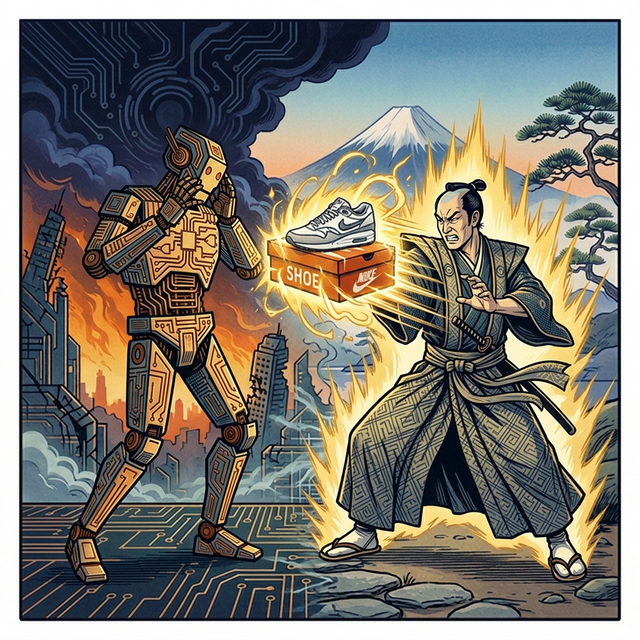
Everything that has a physical, haptic touchpoint with a human has a structural moat against AI automation.
Not because AI can't get better. It will. But because there are certain interfaces AI cannot replace: the product in your hands, the person in the room, the thing that exists in physical space and requires physical presence.
E-commerce sits in an interesting position. It sells a physical product, one that arrives at a door, gets touched, tried on, returned, or kept. That final moment is fully human. AI cannot replicate it.
But every step before that moment? Automatable. The targeting. The content. The logistics optimization. The customer service flow. E-commerce can use the full upside of the AI revolution while its product protects it from the AI displacement risk.
It's the asymmetric position in the whole stack: maximum AI benefit, minimum AI disruption.
Apple understood something similar before anyone named it.
They didn't win the AI race. No competitive frontier model. The car project failed. They integrated Gemini, someone else's intelligence, into their operating system. On the surface, it looks like concession.
I think it's the opposite.
Apple owns the glass. The device. The screen every human looks at, the hardware every interaction passes through. iPhone. Mac. AirPods. Vision Pro. Whatever AI runs on, it runs through Apple's surface layer.
They don't need to build the best model. They rent the intelligence from OpenAI, Google, anyone. And they collect the interface toll regardless of who builds it.
That's not falling behind. That's Standard Oil logic: you don't need to refine the oil if you own the pipeline. Apple owns the pipeline.
The broader principle:
It's not the most capable AI that wins. It's whoever owns the layer between the AI and the human.
In software: the tool that survives isn't the tool with the best output. It's the tool with the best interface. The one people feel comfortable with. The one that fits their workflow, not the other way around.
In business: the companies that survive the automation wave aren't necessarily the ones who automate fastest. They're the ones with a physical product, a recurring human relationship, or a touchpoint that exists in space and can't be replicated at zero marginal cost.
The $25 workflow doesn't destroy every business. It destroys the businesses that were already just selling process, with no physical anchor and no owned relationship.
I left the agency.
Not because I didn't see this coming. Because I did. Process without anchor is not a business in an age of $25 workflows. It's a countdown.
The interface is the only thing left that can't be priced out of existence.
And whoever owns it now will still own it when the next $25 workflow arrives.
The principle is clear. But the real question is which businesses actually have this layer, and which ones only think they do.
Part II: The $25 Test starts with a specific number and a specific workflow. Then it gets uncomfortable. Part III shows what happened when the cost floor itself disappeared. Part IV gives you the map.
This series
Part I: The Human Layer — What AI actually can't replace (you are here)
Part II: The $25 Test — The first filter for your position
Part III: When Coordination Costs Nothing — What the floor looks like now
Part IV: Which Moats Actually Hold — The map with two questions
Newsletter
Only when there is something worth saying. Unsubscribe anytime.
Not advice. I ran an agency. I watched the $25 workflow. Now I watch from a different angle.