My great-grandfather fought under Kaiser Wilhelm.
My grandfather was with the Waffen SS in Kharkov. He survived. He came home from a French prisoner-of-war camp.
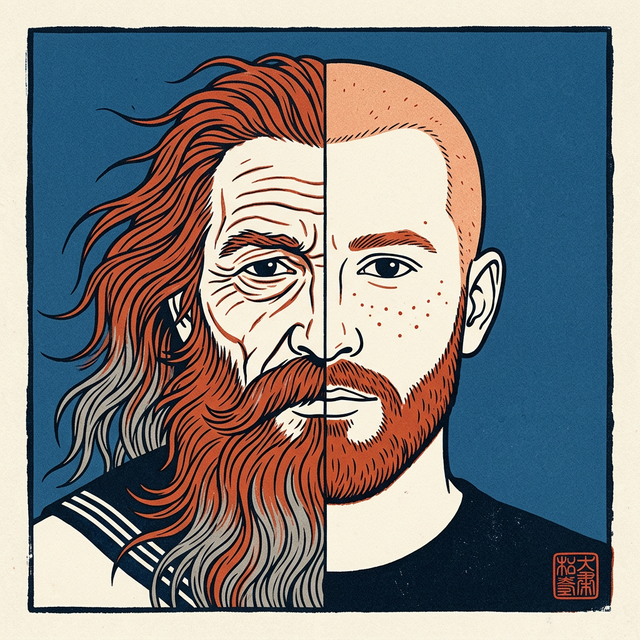
On my mother's side: a stateless sailor. During World War II, he hid in the forests, working as a woodcutter on Bismarck's estates. No country claimed him. He claimed no country. He survived by making himself small and staying mobile.
He had fire-red hair.
I have his beard.
I grew up in a left-leaning household. I am not political. But I am geopolitical. And I am, without question, a pacifist.
And I have built my life accordingly. Though I only understood why when I started writing this.
Ray Dalio spent decades studying the rise and fall of empires. Nassim Taleb studied randomness and what happens when systems get hit by the unexpected. His word for the principle I try to live by: optionality. The deliberate building of flexibility so that when the world shifts, you're not locked in place.
Their shared conclusion: the same cycles repeat. Always. Debt builds up, then violently resets. The reserve currency shifts. Political systems polarize, then break. The United States is not exempt.
What struck me wasn't the history. It was how calm they both were about it. As if knowing the pattern was enough.
I followed my passion first. Film. I made short films as a teenager. I was nominated for the German Youth Film Prize. Got to the Austin Film Festival with a short about my grandfather's dementia. Won a few small awards.
I studied film and media in Vienna and the UK. Then got a role at RTL as an executive producer. Even spent a few months in LA.
I had made it. By the metrics that mattered in that world.
One evening at the Berlinale: I was wearing my RTL badge. In that room, the badge meant money, and people treated you accordingly. A very well-known producer of a very well-known series was standing next to me. Someone at the top of that industry.
He spent ten minutes telling me how bad everything had gotten. How it used to be different. His voice broke.
I looked at my drink. Then at him.
Is that me in twenty years?
Not long after: my contract wasn't renewed. I got a clear view of what the alternative looked like. The freelance production landscape. Projects that lived and died on the mood of a single executive.
The greenlight meeting. Eighteen months of development. The financing was closed. It was supposed to be a formality. Then the head looked around the table and said:
"Ich fühle es irgendwie nicht mehr."
I don't feel it anymore.
That's the decision over millions in budget. Over eighteen months of people's professional lives.
No structural logic. No feedback loop. Just feelings.
I asked myself: where is the wind blowing? Digital. I didn't wait for the perfect landing spot. I applied everywhere and started where they took me.
Best decision I ever made.
That moment taught me something that has only gotten more relevant since.
The world doesn't hold still. AI is compressing everything Dalio described. Cycles that took decades now move in years. Political shifts faster. Power concentrates faster. Industries that seemed stable are being rewritten. The cost of being locked in, financially, professionally, geographically, is rising every year.
I had already seen what it looked like to be locked in. The producer at the party. The project killed with a sentence.
So I built a system for a world in motion.
No debt. That wasn't a financial decision first. It was a feeling. Debt means someone else has a claim on your future. I had watched decisions made on whims. I refused to wear that chain.
Cash. Not everything. But enough to act when others are frozen. Most people treat liquidity as waste. I treat it as the cost of staying free.
Minimal possessions. I just noticed that every thing you own owns a piece of you back. Your attention. Your inertia. Your reason to stay put.
Investments across two systems. US and EU brokers. Different currencies, different legal frameworks. Not paranoia. Just the recognition that concentrated dependency on one system is a single point of failure I don't need.
My base is Germany. Friends, family, culture. That's home. I'm not leaving.
But I've watched people around me go. Portugal. Switzerland. Asia. Germany is changing and the voices saying it's declining are getting louder.
Here's the honest thing: leaving isn't romantic at my age. I know what it costs to start over. New city, new network, new everything. That's real work. I'm not doing that unless I have to.
The point isn't that I want to leave. The point is that nothing in my life makes leaving impossible.
The people who will navigate what's coming aren't the ones who predicted it correctly. They're the ones who built enough flexibility to move as it unfolds.
I don't know what's coming.
That's the point.
My great-grandfather, the sailor, didn't build optionality by design. He had it by necessity. He survived because he was already used to belonging nowhere.
Maybe there's something in the blood. Maybe it passed through every generation that survived by staying mobile, by not holding on too hard.
I have his beard. And now, finally, I understand what he passed down.
Newsletter
Only when there is something worth saying. Unsubscribe anytime.
Not life advice. Just what I do. And why.