I bought Bitcoin in 2017.
A good friend had been in early. His stories triggered me. Meanwhile, we had started buying in the office too. Half the team had something.
It hit around 16k. I made roughly 100% and sold at the high. A colleague from the team did too. He took his girlfriend on vacation with the profit.
Then it crashed. Stayed low for years.
I bought again much later. I'm still holding. A small position.
I could not give you a clean argument for why.
I also have a hardware wallet. Somewhere in my apartment. IOTA, XRP, something called TRON. All bought in 2017. Been sitting there since.
I haven't checked in years.
I also ran a trading bot for two years.
The friend built it. Automated. It jumped between coins based on volatility. Whatever was moving. The coin didn't matter. Any movement worked.
That's not an argument for crypto. That's arbitrage. You could do it with anything.
Then I stopped maintaining it. The agency was busy. The system needed daily attention I didn't give it. It blew up.
What I learned: active trading requires active living inside it. I don't want to watch charts. That's not where my edge is.
I can make money in that world. I just don't want to live in it.
That same friend. Before we even knew each other, he had already been mining Bitcoin with a partner. Graphics cards, stacked rigs, electricity tapped from a warehouse.
Then the partner disappeared. Took the hard drive with all the mined coins.
He didn't quit. He went all-in on Bitcoin. Everything he had.
He doesn't need to work anymore. Lives in Portugal. Runs a German chip shop by the sea. For fun.
That's also a Bitcoin story.
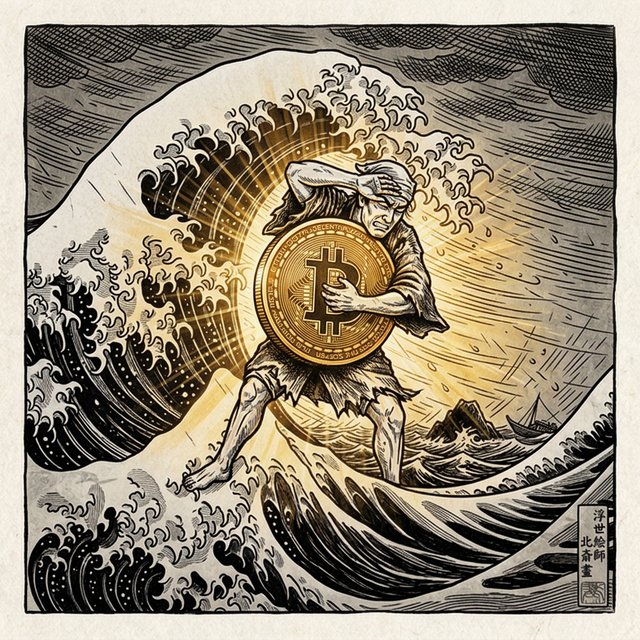
Bitcoin was supposed to be the money outside the system. Decentralized. No government could touch it.
Over a decade in. Where is the adoption?
El Salvador made Bitcoin legal tender in 2021. The biggest real-world test it ever had. In 2025, 92% of Salvadorans had never used it. The government removed mandatory acceptance to secure an IMF loan. The Economist called it a failure.
The machine-to-machine argument lasted longer for me. AI agents will transact autonomously. Someone neutral needs to settle between them. Then OpenAI built its own token system. Anthropic too. Proprietary systems beat neutral standards when the commercial incentive is large enough. The AI labs aren't waiting.
When BlackRock launched the Bitcoin ETF, I thought: this is validation.
It wasn't. The revolution didn't win. It got acquired. The system absorbed Bitcoin, priced it, packaged it, and sold it to pension funds.
That's domestication, not disruption.
Then there's Tether.
Most Bitcoin trading volume runs through Tether, which claims 1:1 dollar backing. In December 2025, S&P Global downgraded Tether's stability to "weak." No full audit. Only attestations. Reserves now include Bitcoin, gold, secured loans.
If Tether is fractional, a large part of Bitcoin's price rests on an unaudited foundation.
Almost nobody in the conversation acknowledges this.
Here's the argument I keep coming back to.
Wirecard. Credible doubters for years. Journalists and short sellers called paranoid. The German government defended the company. The doubters were right.
FTX. People said the numbers looked wrong for years. They were right.
Enron. Same pattern.
The crypto space has a fraud density unlike almost any other asset class. That's not a conspiracy. That's observable.
The pattern: when many smart people feel something is off for a long time, and insiders respond with aggression rather than transparency, that's information.
Not proof. Information.
Bitcoin has had serious, credible doubters for over a decade. Not nocoiners. Economists, investors, people who understand monetary systems.
I've been ignoring those signals. Like most people holding, probably.
Michael Saylor I find genuinely fascinating. Not as a Bitcoin argument.
Before Bitcoin: MicroStrategy, SEC fraud charge, stock down 91%. Then 2020: all-in. He's now a billionaire.
But look at the starting position. If the company was already headed nowhere, going all-in on the most volatile asset is rational. If it fails: same outcome anyway. If it works: everything changes.
That's not a Bitcoin argument. That's power law logic for one man's specific situation.
The smell is getting stronger.
If you have a good argument for Bitcoin, let me know.
I'm still holding.
Newsletter
Only when there is something worth saying. Unsubscribe anytime.
Not advice. A gut feeling I finally wrote down.