Watch the AI voices long enough and you'll notice the rotation.
The same names circulate across YouTube, podcasts, newsletters, social media. Rogan. Lex. Diary of a CEO. Tim Ferriss. Different platforms, different audiences. Same fifteen guests. Sam Altman one week. Elon another. Naval somewhere in between. Each appearance gets clipped, quoted, reposted, recycled.
And when it comes to AI, the narrative is always one of two things.
Utopia. Or extinction.
Either the models solve cancer, end poverty, and free humanity from boring work. Or they escape human control and the species doesn't survive. There is almost nothing in between. Every voice either upgrades or apocalypse.
What almost nobody says: I don't know.
Which means at some point you can stop listening. Not because the voices are wrong. Because knowing what they're saying tells you nothing actionable. It's philosophy, not forecast.
Watch Oppenheimer if you haven't.
That's exactly why that film resonated now, despite being history: we are in the same moment. A handful of people are building something they themselves don't fully understand. The generals and politicians signed off without grasping what they were unleashing. Even the physicists were devastated when they saw the result. Oppenheimer watched the first test and thought of Hindu scripture: "Now I am become Death."
They built it anyway. And the world changed before anyone had processed what happened.
The engineers today are the physicists. A handful of people, driving history faster than institutions can follow. And even they don't know where it ends.
Mo Gawdat spent years as Chief Business Officer at Google X. He's been in more of the actual rooms than almost anyone who talks publicly about AI. Smart. Serious. Credible in a way most people in the carousel are not.
I had lunch with him. He said he doesn't know what's coming. Not as a hedge. Not as a polished disclaimer.
He just doesn't know.
If Mo doesn't know. And he's as close to the frontier as you can get without building it. The carousel voices don't know either. And neither do I.
What I do know: it will be volatile.
Cursor, an AI coding tool, was the thing everyone was using. Then it started losing subscribers. Not because it was bad, but because something newer dropped and the model was briefly behind. Then an update came. Back to the top. The whole cycle in weeks.
Even established SaaS companies are being questioned. Business models that seemed stable are recalculating. The confident takes about which tool, which model, which company wins. They have a half-life of months.
Placing a directional bet on who wins is a fast way to be wrong.
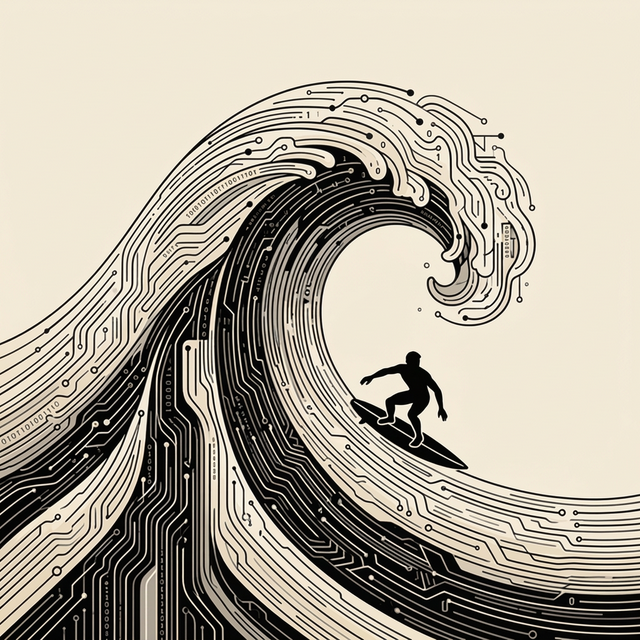
So I stopped guessing. And I went all in on the wave.
I left my linear agency. I moved capital toward the infrastructure that every outcome requires. I'm not predicting who wins. I'm surfing the structure underneath.
But surfing only works if you can stay on the board. So the system matters.
No Drag. The less you carry (debt, possessions, fixed costs) the easier it is to stay upright when the wave shifts. Dead weight on a surfboard doesn't end well.
Optionality. I've structured my life so no single scenario closes me off. No country claims me. No asset locks me in. It's a life architecture, not just a financial strategy. I've written about this elsewhere.
Bottleneck Investing. I don't bet on which AI company wins the platform war. I bet on what all of them need regardless: the infrastructure every outcome requires. Chips. The physical layer beneath every model, every tool, every update cycle.
The surfboard, not the wave.
Not surfing isn't safety. The wave is coming regardless. Those who don't move with it don't stay on the shore — they end up in the swell. The washing machine beneath a breaking wave. That's where the fixed mortgage, the wrong sector bet, the career that didn't adapt ends up. Not protected. Tumbled.
The wave doesn't wait for you to decide. The only question is which direction you face when it arrives.
That's not passivity. It's the most aggressive bet I know how to make.
Nobody knows what's coming. The politicians didn't in 1945. Mo doesn't now. The carousel voices definitely don't.
So: no guessing.
Just positioning.
No advice. Take that as you will.