Goal-setting is good advice. It is also how very smart people work very hard in exactly the wrong direction.
The field matters more than the goal. Almost always.
I have watched people with clear goals, strong discipline, real talent, working hard in a field that was closing around them. And I have watched people with the wrong goal, sometimes no goal at all, get carried forward because the field they were standing on had the right wind.
The field is not everything. But it is more than most people think. I spent most of my career learning this the slow way.
The field can be an industry. A department. A company. A role where the layer above you has not moved in five years. The question is always the same: is this field open, and can I move on it?
No goal.
I worked as a TV executive. I prepared committees. I wrote recommendations. I sat in the rooms where decisions were made about which projects moved forward and which did not.
I watched a project developed over eighteen months get rejected on criteria that had nothing to do with the project. The people who built it could not intervene. They probably did not understand what decided it.
The money flowed in from public broadcasters and commercial television. It flowed out to productions. Then it flowed back in fees, in co-productions, in infrastructure controlled by the same institutions. The same names decided. The same names received.
This is not a complaint. It is a structural observation. The field was closed.
The signal was not dramatic. In the corridors of our own broadcaster, everyone was whispering: Netflix is coming. The fear spread as if the end was near. I checked the earnings reports. Record revenues. Record profits. The broadcaster was doing fine. But the people inside could already feel the wind changing before the numbers showed it.
Fear plus record profits means the field is turning.
No goal inside that field would have changed the structure. I could have been more talented, more connected, more persistent. The result would have been the same.
I took the signal and left entirely.
Choose field.
Where was the wind going?
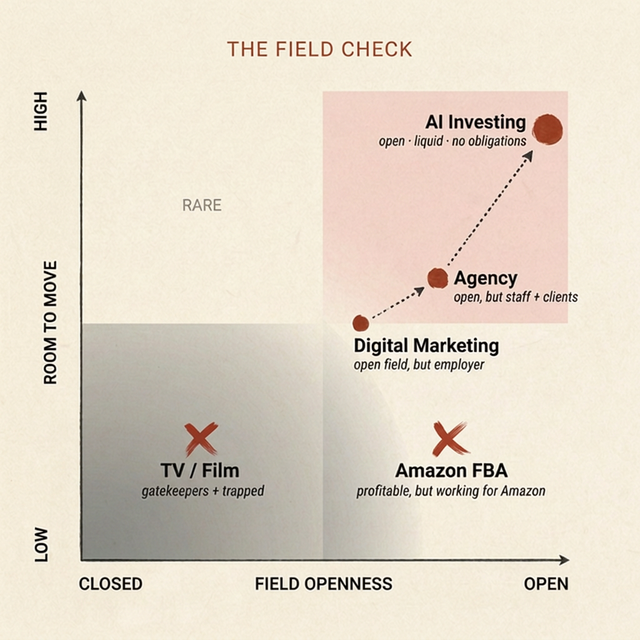
At the time, my then-girlfriend worked at one of the most hyped digital agencies in the world. Wild west. Everything went. The contrast to the corridors I had just left was total: there, fear and full bank accounts. Here, chaos and growth and nobody had any idea what was happening, but it was clearly moving.
I applied to digital agencies without the skills to justify it. Most did not call back. One did. They had noticed that YouTube was becoming something real, and my background in visual storytelling was adjacent to a field they had not fully named yet.
I joined knowing almost nothing. And then: everyone wanted what we had, and nobody understood it. Clients came with budgets and questions and we simply moved faster than the market. When Facebook Ads started working for mainstream brands we were already there. We had the answers. They had the budgets. It only went up.
Three years later I led the department. Revenue doubled. Field chosen. Field working.
Then I started my own agency.
Before I entered the digital field, two questions sorted it for me:
Is this field opening or closing? And can I leave it in a week if I need to?
That second question is about exit speed. Most people never ask it on the way in. Only on the way out, when it is too late.
Switch with speed when certain.
Around 2016, I tested Amazon FBA. Thirty percent margin. Real profit.
I killed it.
Once inside, the field controlled everything. Every euro of profit went back into inventory. Amazon decided rankings, visibility, payouts. My exit speed was effectively zero. That told me enough.
The agency I worked on was good. It was built for the moment I built it in.
There was no single moment that made it clear. Several things happened over a few years and each one alone could have been noise. Cambridge Analytica and GDPR changed the rules of the game in digital marketing fundamentally and permanently. Google and Meta began automating what agencies used to do manually. After the pandemic tailwind ran out, clients who had spent heavily pulled back and the market got quiet. And then AI started changing not just the budget conversations but the actual work inside the agency.
None of those signals forced a decision. Together they drew a picture. The field I had entered was still open, but the wind was shifting inside it. Moving at the speed I wanted, preparing for what was clearly coming, was not possible from within.
So I left. Clean. Fast.
The field I am standing on now is AI. Specifically, how capital flows through it and where value concentrates.
Think of it like Battleships. A goal-thinker fires at a specific square. A field-thinker asks which sector is most likely to contain something, commits to a zone, and updates as information comes in. Not a point. A position.
I hold a concentrated position in semiconductor infrastructure because everyone building in AI crosses that layer regardless of where they end up. Not a bet on which application wins. A position on the field that all of them must cross. Fully liquid. Exit speed: one week.
Goals feel precise. Fields feel uncertain.
But precision is an illusion when the wind changes direction.
I have switched fields four times. Television. Digital. Agency. AI. I did not know exactly how any of them would unfold. I knew where I wanted to stand when the wind came. And I knew I needed the exit speed to move again when it did.
Most people ask the exit question on the way out. I ask it on the way in.
When you are standing in the right field, even a mediocre goal is enough. The wind does the rest.
Goal-setting is not wrong. It is just not the most important question. Pick the field first.
Picking the field is one thing. What comes after is a different decision: committing fully, burning your options, not keeping an exit open just in case. I wrote about that here.
Newsletter
Only when there is something worth saying. Unsubscribe anytime.
Not advice. An observation from someone still mid-field.