There's an exercise I keep coming back to.
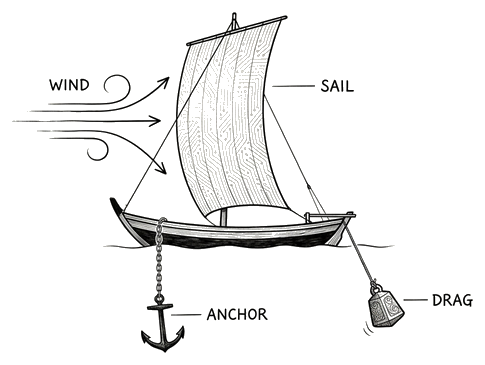
Draw a sailboat. Below the waterline: anchors. Everything slowing you down. Above: sails. What's catching wind. And the wind itself: the forces outside your control that are either pushing you forward or working against you.
The exercise sounds simple. It isn't.
Most people don't actually know what wind they're in.
In early 2020, my agency almost didn't survive March.
We'd just hired two people. Then COVID hit. Within weeks we had to put them on short-time work. Three months of not knowing what was coming. We applied for government support just to keep the lights on.
Then something changed.
Overnight, every company that had ignored e-commerce for ten years suddenly needed it. Not eventually. Now. And we were one of the few agencies that had already built a track record in the space. Strong cases. Proven results. Confidence that we could deliver 100% growth in three months.
We didn't engineer that. We were just in the right place when the wind turned.
And the wind turned hard.
What followed was disorienting. We ran. That's the honest word for it. We ran. Our clients' e-commerce accounts went through the roof. Case after case. New accounts before we'd finished the last one. We forgot some. Systems didn't exist and had to be built mid-sprint. We went from a small team scrambling to survive to a mid-size agency I barely recognized.
We understood a lot. We did a lot right. But we were learning while running, and the wind was doing most of the heavy lifting.
2021 and 2022 were the best years financially.
Then, in 2024 and 2025, the wind shifted.
A full reversal: pandemic money that had flooded markets came back out, supply chains normalized, pandemic winners pulled back, wars, inflation, insolvencies. A mix of everything hitting at once.
The wind turned against almost every industry simultaneously. Not just us. That's the thing about macro headwinds. They don't discriminate.
We handled it well. But I felt the drag. And for the first time, I started asking a real question.
Am I sailing. Or just drifting with nowhere clear to go?
I'd seen this pattern before, in smaller forms.
Robotics in 2007. Facebook Ads and YouTube in 2016. Each time: an early signal, a wave building, a window before it became obvious to everyone.
With AI, there were two moments that made it impossible to look away.
The first: when Google launched Performance Max. One campaign type. Fully automated. No manual control. The stated goal: make ads work for anyone, even without expertise. I looked at that and thought: that's not a product update. That's a declaration. If Google is willing to automate this end-to-end, everything built on human judgment in digital marketing is on a clock.
The second: at 25 employees, I started thinking about what the agency would look like built from scratch as an AI orchestration platform. Not an agency using AI tools. An AI system with humans in oversight. I sketched what that would require. What would have to be true. What would break.
Between those two moments and December 2025, I spent a year building evidence. Reading. Testing. Questioning my own assumptions. Challenging every conclusion. I didn't want conviction built on excitement. I wanted conviction that had survived its own scrutiny.
By the time I exited the agency in December 2025, the decision was already made. Not impulsive. Built.
Then in early 2026 I came across OpenClaw. Complex, multi-step workflows running via WhatsApp commands. No interface. No team. Just an agent doing what used to take multiple people and several tools.
That was the approach I'd sketched out. Already built. Already working. Already generalized far beyond any niche.
I wasn't early this time. But I was positioned to understand exactly what I was looking at. And how fast it had moved.
So: I'm burning the boats.
All in. On the direction. On the infrastructure layer. On the wave, not the foam around it.
Everything creating drag. I'm cutting it.
Not because I'm certain about the shape of what's coming. Because I've pressure-tested my own conviction and it held.
I expect crashes. A lot of companies will not survive the correction that's coming in AI. You've seen it before. Railways. Electricity. The internet. The crash of 2000 was brutal. The fiber optic cables stayed in the ground anyway.
The crash doesn't change the direction. It clears the tourists.
I intend to still be here when the field clears.
This is not optimism. Optimism is vague.
This is conviction. Built slowly. Challenged repeatedly. And still standing.
The boats are burning.
I chose the fire.
Newsletter
Only when there is something worth saying. Unsubscribe anytime.
This isn't a recommendation. This is what I'm doing and why. Your bet has to be your own.