Everyone tells me I should buy a house.
People who know me well. People who barely know me. Colleagues. Family. Advisors.
I keep asking why.
The answers are always the same: because that's what you do. Because it's an investment. Because it's safe. The ultimate store of value, people say. Because AI can't destroy a house.
That's not a strategy. That's a script passed down from a generation that played a different game.
My parents' generation had a plan. It made sense for their world.
Long, stable job. Affordable property. Mortgage over 25 years. Retire with a paid-off house and a garden.
It worked. For them. In that era. Under those conditions.
My parents could have bought our family home when I was a child. The price was still within reach. They didn't. Right call or wrong one, I still don't know.
But I keep returning to that story. Because the conditions that made their plan plausible no longer exist.
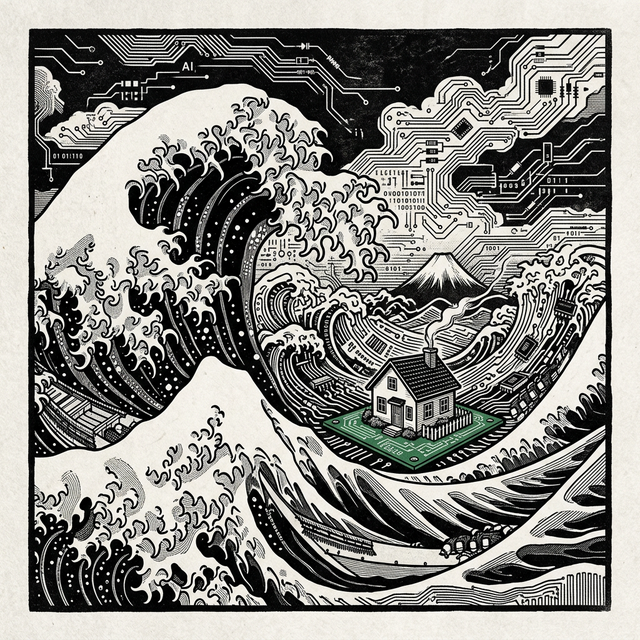
Here's what it actually looks like today.
I know a senior executive. Good salary, experienced, disciplined saver. He moved to Duisburg. Not because he wanted to live in Duisburg. Because Düsseldorf, where he actually wanted to be, didn't work financially at his life stage. That's the compromise. A city you didn't choose. And a commute you didn't plan for.
I know someone else who paid close to a million euros for a house on the outskirts of Hamburg. That's now a normal price for a normal house in a good area. Six-figure income. Solid position. And still: the mortgage owns them for the next thirty years. Not twenty-five anymore. Thirty, sometimes more. Half a life.
And I know a couple who built their house during the pandemic. Costs exploded mid-construction. Ten, fifteen, twenty percent over budget. They ended up paying far more than planned. When I asked how they feel about it, the answer was: "If it doesn't work out, we'll sell."
Their dream house. That they'd just built.
That sentence stayed with me.
The thing most people don't say out loud: a mortgage doesn't just take your money. It takes your options.
You can't move for a better opportunity. You can't take a real risk on a new venture. You can't spend a year reorienting if the world shifts.
And the world is shifting.
My highest value is autonomy. Not comfort. Not status in the conventional sense. I like my sports car, so I'm not pretending I'm above material things. But autonomy. The ability to move, to decide, to change direction when the evidence changes.
A mortgage is the systematic removal of that. For thirty years.
Now let's do the math they don't show you in the brochure.
A million-euro house. That's not a luxury property anymore. That's a normal house in a good area of any major German city. Twenty percent down: two hundred thousand euros. Mortgage on the rest at current rates: roughly three thousand euros a month in interest alone. Before repayment. Add one percent for maintenance: another eight hundred a month. Add property tax.
You're above four thousand euros a month before the house gains a single euro in value.
And the purchase costs nobody leads with: notary, transfer tax, agent. Depending on the market, that's eight to twelve percent on top. On a million-euro house, you lose up to a hundred thousand euros the moment you sign. Gone. You'll never earn it back.
Meanwhile, comparable rent outside Hamburg: maybe two thousand five hundred.
You pay more to own than to rent. And you've locked up your capital, your geography, and thirty years of your life in the deal. The person who told you it's a sound financial move probably didn't run those numbers either.
I understand the counter-argument. Property builds equity. Renting is dead money.
Maybe. In a different era, at different rates, in markets that rose reliably for decades. Today those conditions are gone. The counter-argument assumes a world that no longer exists.
We're in the early stages of an exponential era. It rewards mobility, concentration, and speed. Locking eighty percent of your capital into a single illiquid asset that yields three to five percent gross is not a wealth strategy. It's a wealth anchor.
Real estate protects you from inflation. Except when it doesn't. And it doesn't protect you from being left behind.
I'm not saying property is always the wrong answer.
Roots, stability, a place your family calls home for decades. Those are real values. Own that choice.
But own it as a values decision. Not a financial one. Not a default.
Because in an exponential era, the most dangerous thing you can hold is a reason that stopped being true ten years ago. And never noticed.
The numbers are in Part II.
Newsletter
Only when there is something worth saying. Unsubscribe anytime.
I'm not telling you not to buy. I'm telling you to actually choose.