When I was a student, I worked as a bartender and waiter.
I saved the money. Then I did something that most students don't do: I booked an appointment at my bank.
The advisor sold me managed funds. Classic.
But I also had a hunch. Robotics was going to be big. I could feel it. So I asked for a managed robotics fund on the side.
That was around 2007, 2008.
It worked really well.
Then I sold everything. I needed the money to finance my studies in England.
Right instinct. Early. Sold anyway.
I've been here before.
Years later I looked at what most investors actually do.
They buy the S&P 500. MSCI World. Broad diversification. Sensible advice.
But here's the problem with broad during a GPT wave.
You get the winners. You also get everything else. Steel companies. Legacy banks. Retail from the last century. You're dragging the entire old economy alongside the new one.
Every percentage point gets diluted.
The alternative is stock picking. But picking is brutally hard. You have to be right about the company, the timing, and hold through the volatility. I don't trust myself to do that consistently. Most people who think they can are wrong.
So I asked a different question.
If AI is really the next technological wave, and the internet was the last one, then the proof should already exist. Historical data. Hard numbers.
I went looking.
What I found stopped me cold.
The Numbers
If the internet was the last GPT wave, its infrastructure layer should show up in the data.
The indexes that track it: NASDAQ 100 (tech) and SOXX (Philadelphia Semiconductor Index).
Here's what $10,000 invested 15 years ago looks like today:
| Index | Annual Return | $10,000 becomes... |
|---|---|---|
| S&P 500 | 10% | $41,000 |
| NASDAQ 100 | 16% | $92,700 |
| SOXX (Semis) | ~18% | ~$132,000 |
Same 15 years. Same starting point. Over 4× difference between the broad market and the semiconductor index.
Buffett-like compounding. Without stock picking. Without genius.
Just owning the infrastructure layer of the last technological wave.
That was the moment I couldn't unsee it.
Why Does This Happen?
Because every generation has one technology that changes everything. Economists call it a General Purpose Technology, a GPT.
Steam. Electricity. Internet. AI.
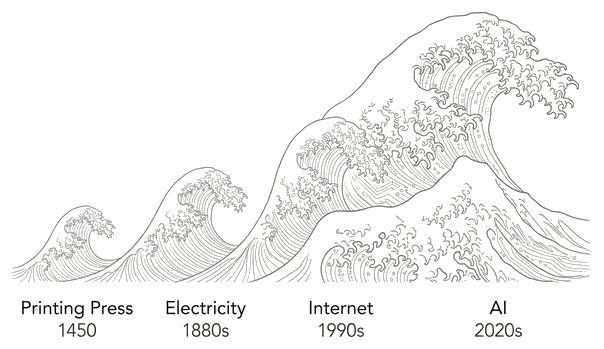
Each follows the same three phases:
Phase 1: Infrastructure. The rails get built. Expensive, slow, mostly invisible. Most companies fail. Returns look terrible.
Phase 2: Application boom. Speculation explodes. Hype exceeds reality. A bubble forms and bursts.
Phase 3: Productivity. The technology embeds into everything. GDP accelerates. The bubble burst didn't matter. The technology stayed.
| GPT | Infrastructure | Bubble | Productivity | Lag |
|---|---|---|---|---|
| Steam Engine | 1769–1830 | 1840s Railways Mania | 1850–1880s | ~60 yrs |
| Electricity | 1880s–1910s | 1920s boom | 1940–1960s | ~50 yrs |
| Internet | 1990–2000 | Dot-com 1998–2000 | 2005–2020 | ~20 yrs |
| AI | 2020–2027? | 2025–2030? | 2030–2040? | TBD |
The lag keeps getting shorter. The pattern holds every time.
The Internet Taught Us This
NASDAQ rose 572% from 1995 to March 2000. Then crashed 78%. Five trillion dollars in market cap wiped out, and most dot-com stocks gone.
But the fiber optic cables stayed in the ground. Amazon survived. Cisco lost 80% of its value and then became the backbone of the internet. The speculators lost. The infrastructure won.
Who built the internet's infrastructure? Chip companies, network equipment, software. Their stocks crashed in 2000 and then compounded at 16–18% annually for the next 15 years.
That's the trick. You didn't need to pick the winning apps. You needed to own the layer beneath them.
Where We Are Now
Phase 1: Infrastructure. We're in it.
Nvidia makes the picks and shovels. $500 billion in data center investment is being announced globally. Every major cloud provider is spending at levels that look insane.
They looked insane in 1998 too.
There's a sobering footnote buried in economic history. Over the last 180 years, whenever infrastructure investment exceeded roughly 3% of GDP, it temporarily bankrupted the economy — sometimes for a decade. It happened twice with railways, once with electrification, once with highways. Each crash was real. Capital was destroyed. Companies failed. And each time, the technology survived and reshaped everything that followed. The crash is not the story. It's a rounding error on a 50-year return.
Goldman Sachs projects AI adds $7 trillion to global GDP, but says impact is "near zero" in 2025. The productivity ramp starts around 2027.
McKinsey projects AI and automation could handle 50% of all work tasks. Midpoint: around 2045.
| Period | What Likely Happens |
|---|---|
| 2025–2027 | Infrastructure build. Chips, data centers, energy. High volatility. Data centers starting now won't be online until 2028–2029. |
| 2027–2030 | Application layer matures. Winners separate. First productivity data appears. |
| 2030–2035 | Productivity boom in GDP. Labour markets restructure visibly. |
| 2035–2045 | Full embedding. Robotics wave. Next GPT probably emerging. |
The Conclusion That Keeps Me Up At Night
If the semiconductor index compounded at ~18% annually through the last GPT wave —
And we are now at the beginning of the next GPT wave —
Then the question isn't whether to invest in AI infrastructure.
The question is why anyone is looking anywhere else.
$10,000 in AI infrastructure in 2025. If history rhymes: ~$132,000 by 2040.
But here's the part that keeps me up at night:
Every GPT so far has been bigger than the last. Steam gave way to electricity. Electricity gave way to the internet. Each wave was larger, faster, more transformative.
Most economists who study this say AI is the biggest GPT ever recorded.
If that's true, then 18% annually isn't the forecast.
It's the floor.
That's not a prediction.
That's a pattern. Verified three times. Potentially about to exceed itself.
I'm betting on a fourth.
The pattern is clear. But a pattern alone isn't actionable. Part II: The Numbers puts 19 years of hard data behind it: four asset classes, side by side, and what that means for the next wave.
Newsletter
Only when there is something worth saying. Unsubscribe anytime.
Not financial advice. Historical returns do not predict future results. But patterns do tend to rhyme.